Who’s Liable in a Left-Turn Motorcycle Accident in Virginia?
Left-turn collisions are among the most common and most dangerous types of motorcycle accidents in Virginia. Because motorcycles are smaller, faster to approach, and harder to judge in distance and speed, drivers turning left across traffic frequently misjudge an oncoming motorcyclist — with devastating consequences.
Experienced Result Oriented Motorcycle Accident Lawyers in Virginia

Call Now – FREE Consultation
If you’ve been involved in a left-turn motorcycle accident in Virginia, understanding who’s liable, and how Virginia law treats these cases, is essential to protecting your right to compensation. Our Virginia motorcycle accident law firm has represented riders throughout the Commonwealth in these exact cases, and this guide breaks down the legal issues involved.
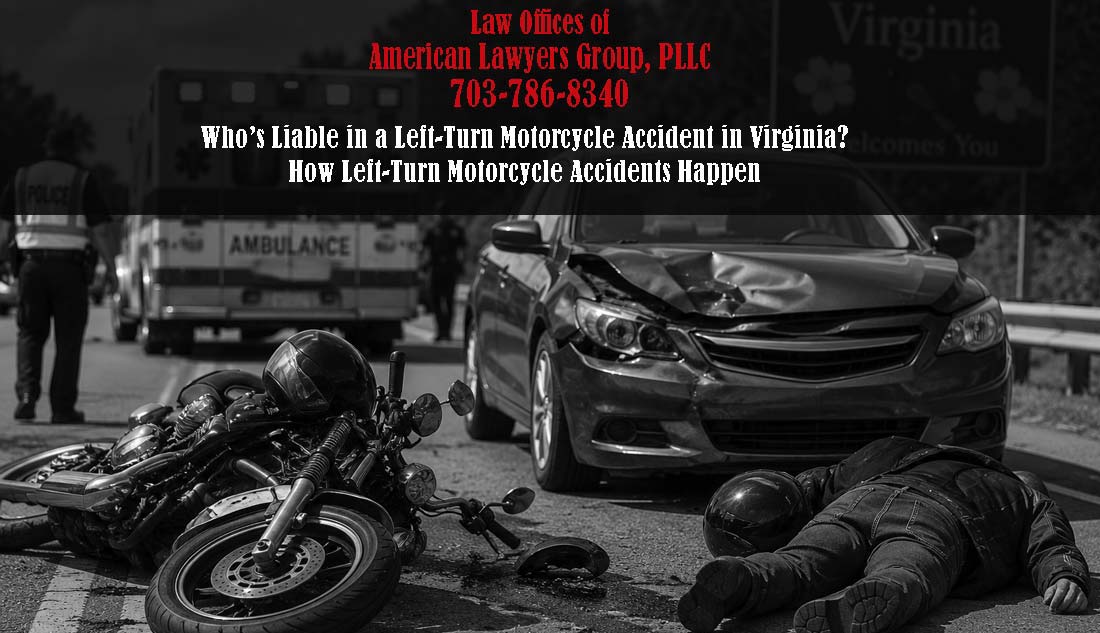
How Left-Turn Motorcycle Accidents Happen
A left-turn motorcycle accident typically occurs when a driver turning left across an intersection — often from a stopped or slowed position — pulls into the path of an oncoming motorcyclist. This is frequently described as a driver who “didn’t see” the motorcycle, a phenomenon safety researchers call “looked but failed to see.” Common scenarios in a Virginia left-turn motorcycle crash include:
A driver turning left at a green light misjudges the motorcycle’s speed or distance
A driver turning into a driveway or parking lot fails to see an approaching motorcycle
A distracted driver, checking a phone or dashboard, fails to notice the motorcyclist at all
A driver turning left on a stale yellow or after the light changes, cutting off the rider
Sun glare, poor visibility, or an obstructed view of the motorcycle
Because motorcycles present a smaller visual profile than cars or trucks, left-turn accidents involving motorcyclists are disproportionately common — and disproportionately severe, given the complete lack of protection a rider has compared to a vehicle occupant.
Virginia’s Left-Turn Right-of-Way Law
Virginia law is clear about who has the right-of-way when a vehicle turns left across oncoming traffic. Under Virginia Code § 46.2-825, a driver intending to turn left within an intersection, or into an alley, private road, or driveway, must yield the right-of-way to any vehicle approaching from the opposite direction if that vehicle is close enough to constitute a hazard. This duty applies whether the oncoming vehicle is a car, truck, or motorcycle — a driver cannot claim ignorance of a motorcyclist’s right-of-way simply because a motorcycle is smaller or less visible than a typical vehicle.
The only major exception involves intersections with a dedicated left-turn signal: under § 46.2-825, a vehicle turning left on a protected green arrow has the right-of-way over opposing traffic, including motorcyclists, for the duration of that signal.
Virginia’s model civil jury instructions, based directly on § 46.2-825, instruct juries that a driver turning left has an affirmative duty to yield — meaning that in the majority of left-turn motorcycle accidents, the turning driver bears primary legal responsibility for the crash.
Who Is Typically at Fault in a Left-Turn Motorcycle Accident?
In most cases, the driver making the left turn is the at-fault party under Virginia Code § 46.2-825, since the law places the duty to yield squarely on the turning vehicle. However, liability isn’t always limited to the turning driver. A thorough investigation by a Virginia motorcycle accident attorney may reveal that:
The turning driver ran a stale yellow or red light
The motorcyclist was traveling significantly over the speed limit, making the crash difficult to avoid
A third vehicle obstructed the turning driver’s view of the motorcycle
A traffic signal malfunctioned
The motorcyclist was lane splitting, which is illegal in Virginia (discussed below)
Because insurance companies representing at-fault drivers frequently attempt to shift blame onto the motorcyclist — often relying on common biases against riders — a detailed investigation into speed, sightlines, and signal timing is critical to a successful motorcycle accident claim.
Motorcycle-Specific Laws That Can Affect Liability
Certain Virginia motorcycle laws can become relevant in a left-turn accident if a driver’s insurance company attempts to argue the rider contributed to the crash:
Lane splitting is illegal in Virginia. Under Virginia Code § 46.2-857, driving between lanes of traffic is treated as reckless driving. If a motorcyclist was lane splitting at the time of a left-turn collision, an insurer may argue this contributed to the crash.
Riding two abreast is legal. The same statute, § 46.2-857, expressly permits two motorcycles to travel side by side within a single lane, so this common riding practice cannot be used to argue fault.
Helmet requirements. Virginia Code § 46.2-910 requires DOT-, Snell-, or ANSI-approved helmets for all riders, and a violation can result in a citation, though it does not automatically establish fault for the crash itself.
Virginia’s Contributory Negligence Rule and Motorcycle Accidents
Virginia follows the strict common-law doctrine of contributory negligence, one of the harshest fault rules in the country. Under this rule, if an injured motorcyclist is found even slightly at fault for the collision, they may be completely barred from recovering any compensation — regardless of how clearly the turning driver violated Virginia Code § 46.2-825. Insurance companies are well aware of this rule and often lean on riding stereotypes to argue that a motorcyclist was speeding, lane splitting, or otherwise partially at fault. This makes it especially important to work with an experienced Virginia motorcycle accident lawyer who can counter these tactics from the outset.
Steps to Take After a Left-Turn Motorcycle Accident
If you’ve been involved in a left-turn motorcycle accident in Virginia, the following steps can help protect your health and your legal claim:
Call 911 and request police and medical assistance immediately.
Seek medical attention, even if injuries seem minor — motorcycle crashes frequently cause internal injuries not immediately apparent.
Get a copy of the police report, which will document how the crash occurred and any citations issued.
Document the scene with photos of vehicle position, skid marks, traffic signals, and your motorcycle’s damage.
Collect witness information from anyone who saw the crash.
Avoid discussing fault with the other driver or their insurance company.
Preserve your riding gear, which can serve as evidence of impact location and severity.
Contact a Virginia motorcycle accident attorney before speaking with any insurance adjuster.
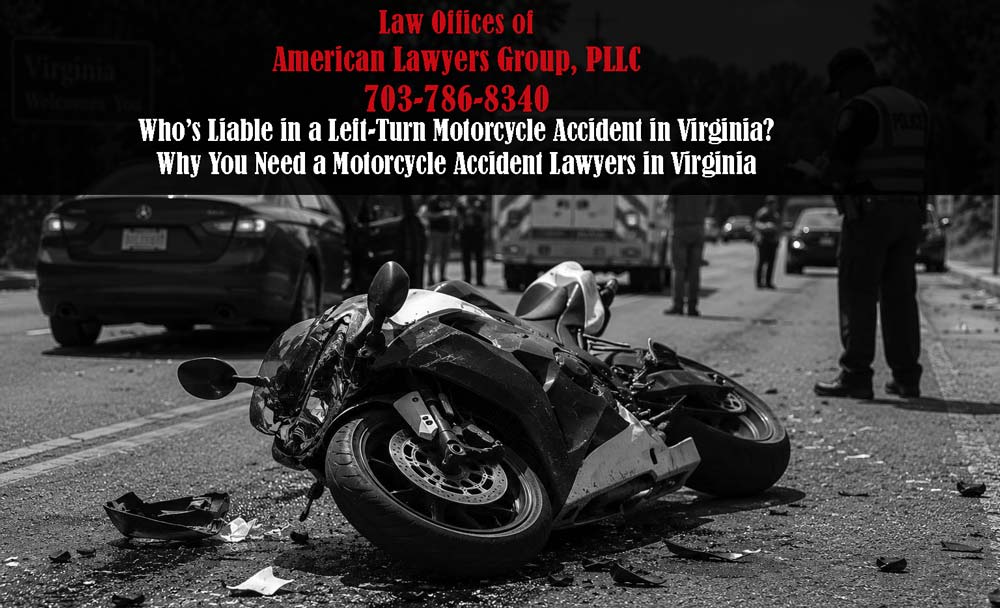
Why You Need a Motorcycle Accident Lawyers in Virginia
Left-turn motorcycle accident cases often come down to a battle over fault, speed, and sightlines — and insurance companies frequently exploit bias against motorcyclists to reduce claim value. An experienced Virginia motorcycle accident lawyer can:
Investigate the crash scene, traffic signal timing, and witness accounts
Obtain the police report and any citations issued under Virginia Code § 46.2-825
Work with accident reconstruction experts to establish speed and sightlines
Counter insurance company attempts to blame the motorcyclist
Calculate the full value of your claim, including future medical care
Negotiate with the driver’s insurance company or litigate your case in court
Compensation Available After a Left-Turn Motorcycle Accident
Victims of a left-turn motorcycle accident in Virginia may be entitled to recover:
Medical expenses, current and future
Lost wages and diminished earning capacity
Pain and suffering
Permanent disability or disfigurement
Property damage to the motorcycle and riding gear
Punitive damages in cases involving especially reckless conduct
Under Virginia Code § 8.01-38.1, punitive damages in any Virginia civil case are capped at $350,000, regardless of the jury’s initial award or the number of defendants. This cap applies only to the punitive component of a claim — compensatory damages for medical bills, lost income, and pain and suffering are not subject to this limit.
Virginia’s Statute of Limitations for Motorcycle Accident Claims
Under Virginia Code § 8.01-243, most personal injury claims arising from a motorcycle accident must be filed within two years from the date of the crash. If a rider tragically dies from their injuries, Virginia Code § 8.01-244 generally requires a wrongful death claim to be filed within two years of the date of death. Certain circumstances may toll or extend these deadlines under Virginia Code § 8.01-229, but the exceptions are narrow. Waiting too long to pursue a Virginia left-turn motorcycle accident claim can permanently bar you from recovering compensation.
Frequently Asked Questions About Left-Turn Motorcycle Accidents in Virginia
Is the driver always at fault in a left-turn motorcycle accident? In most cases, yes. Under Virginia Code § 46.2-825, a driver turning left must yield to oncoming traffic, including motorcycles, if that traffic is close enough to constitute a hazard. Exceptions exist, such as when the driver had a protected left-turn arrow.
Experienced Result Oriented Motorcycle Accident Lawyers in Virginia

Call Now – FREE Consultation
Can the motorcyclist be blamed for a left-turn accident? Insurance companies sometimes try to argue the motorcyclist was speeding, lane splitting, or otherwise partly at fault. Because Virginia follows contributory negligence, even a small share of fault can bar recovery, making a thorough investigation critical.
Is lane splitting illegal in Virginia? Yes. Under Virginia Code § 46.2-857, lane splitting is treated as reckless driving. However, riding two abreast in a single lane is explicitly legal under the same statute.
How long do I have to file a motorcycle accident lawsuit in Virginia? Under Virginia Code § 8.01-243, you generally have two years from the date of the crash to file a personal injury lawsuit.
What should I do if the driver’s insurance company contacts me? Avoid giving a recorded statement, admitting fault, or accepting a quick settlement before speaking with a Virginia motorcycle accident lawyer.
Why Choose Our Virginia Motorcycle Accident Law Firm
Our firm represents motorcyclists injured in left-turn accidents throughout Virginia, including Fairfax, Richmond, Norfolk, and the surrounding regions. We understand the biases riders face from insurance adjusters, and we build cases that hold turning drivers accountable under Virginia Code § 46.2-825 while protecting our clients from unfair contributory negligence arguments. Our team works on a contingency-fee basis, meaning you pay nothing unless we win your case.
If a driver turned left in front of you or a loved one, don’t wait to protect your rights. Evidence disappears quickly, and Virginia’s statute of limitations is strictly enforced. Contact our Virginia motorcycle accident attorneys today for a free, no-obligation consultation.