Common Causes of Bus Accidents in Fairfax
Every single day, thousands of commuters, students, and visitors rely on public and private bus transportation systems to traverse the dense and complex roadways of Fairfax County, Virginia.
Experienced Result Oriented Bus Accident Attorneys In Fairfax

Call Now – FREE Consultation
From the extensive routes of the Fairfax Connector and the Washington Metropolitan Area Transit Authority (WMATA) Metrobus network to local Fairfax County Public Schools (FCPS) school buses and commercial interstate carriers like Greyhound, buses form the backbone of regional mobility. However, due to the sheer size, massive weight, and unique operational dynamics of these commercial vehicles, when a bus crash occurs, the resulting aftermath is frequently catastrophic.
Navigating the legal aftermath of a mass transit collision or a private commercial bus wreck is fundamentally different from a typical passenger car accident claim. Bus accidents involve intricate layers of state and federal regulations, complex corporate organizational structures, municipal liability doctrines, and aggressive insurance companies intent on minimizing exposure. For victims suffering from severe physical trauma and mounting financial duress, securing competent legal counsel is paramount. At American Lawyers Group, PLLC , our dedicated team of personal injury professionals stands ready to provide the sophisticated advocacy required to go toe-to-toe with powerful transit entities and corporate insurers.
What should I do first if I am injured in a bus accident?
The chaotic moments immediately following a bus collision can be overwhelming, confusing, and intensely stressful. Whether you were a passenger on the bus, an occupant of another vehicle involved in the crash, or a pedestrian struck by a bus, the actions you take in the immediate aftermath are critical to protecting your health and preserving your legal right to financial recovery. Taking systematic, precise steps ensures that vital evidence is captured before it disappears and that your medical needs are fully documented.
1. Prioritize Immediate Physical Safety and Medical Attention:
Your absolute first priority must be your health and safety. Check yourself and others for injuries. Immediately dial 911 to dispatch emergency medical services and law enforcement personnel to the scene.
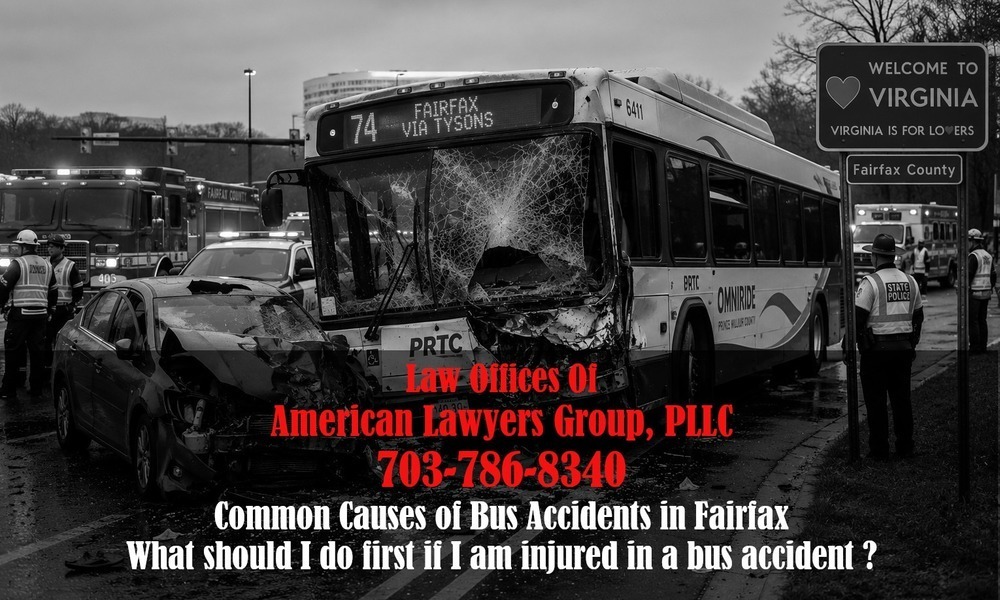
Even if you believe your injuries are minor or that you are simply shaken up, you must be evaluated by a medical professional. The rush of adrenaline following a high-impact collision can easily mask severe, underlying soft-tissue injuries, internal hemorrhaging, or traumatic brain injuries.
Delayed medical treatment not only endangers your life but also provides insurance companies with a pretext to claim your injuries were not caused by the accident.
2. Ensure Law Enforcement Files an Official Accident Report:
In Virginia, a law enforcement officer responding to a commercial vehicle or transit accident will conduct a thorough scene investigation and file a formal police crash report. Ensure that the responding officer speaks with you, takes your statement, and accurately records your version of events. This official report serves as a foundational piece of evidence in establishing liability, capturing critical data points such as weather conditions, traffic violations, and mechanical observations.
3. Document the Scene and Gather Comprehensive Evidence:
If your physical condition permits, or if you have an uninjured companion who can assist, use your smartphone to thoroughly document the scene of the accident. Take high-resolution photographs and videos from multiple angles, capturing the final resting positions of all vehicles, property damage, skid marks on the pavement, traffic signals, road construction hazards, and any visible injuries you have sustained. Note the bus number, license plates, operating agency or company name, and the specific route number.
4. Identify and Collect Witness Information:
Bus accidents often occur in public, highly visible areas, attracting numerous onlookers and involving dozens of passengers. Independent witnesses who are not affiliated with any party involved provide highly credible, unbiased testimony. Collect the names, phone numbers, and email addresses of fellow passengers, occupants of other vehicles, and pedestrians who witnessed the crash. Do not rely on the police to gather every witness statement.
5. Report the Incident to Your Own Insurance Carrier:
Promptly notify your auto insurance provider about the accident, even if you were a passenger or pedestrian. Provide basic, factual information without speculating on fault or the full extent of your injuries. Many policies feature Medical Payments (MedPay) coverage or Uninsured/Underinsured Motorist (UM/UIM) provisions that may offer crucial financial support during your recovery.
6. Avoid Direct Statements to the Bus Company’s Insurance Adjusters:
Within days or even hours of the crash, representatives or risk management adjusters from the public transit authority or private bus line will likely contact you. They may offer a quick, seemingly generous cash settlement or request that you give a recorded statement regarding the accident. Do not sign any documents or agree to any recorded statements without an attorney present. These companies are looking out for their bottom line, and their primary objective is to get you to inadvertently waive your rights or make statements that diminish the value of your claim.
Crucial Legal Warning:
Commercial transit providers maintain rapid-response teams consisting of corporate lawyers, investigators, and adjusters who deploy to accident scenes immediately to mitigate liability. Retaining a qualified personal injury firm like American Lawyers Group, PLLC right away ensures that your interests are protected by an equally aggressive legal team from day one.
Who might be liable in a bus accident?
Determining liability in a bus accident requires a deep understanding of state tort laws, corporate liability principles, and federal commercial vehicle safety standards. Unlike a simple two-car accident where fault rests on one of the drivers, a bus accident frequently involves a complex web of potential defendants. Under Virginia law, commercial bus operations are categorized as common carriers . Common carriers are legally bound to exercise the highest degree of practical care, diligence, and foresight for the safety of their passengers, creating a elevated standard of accountability compared to ordinary motorists.
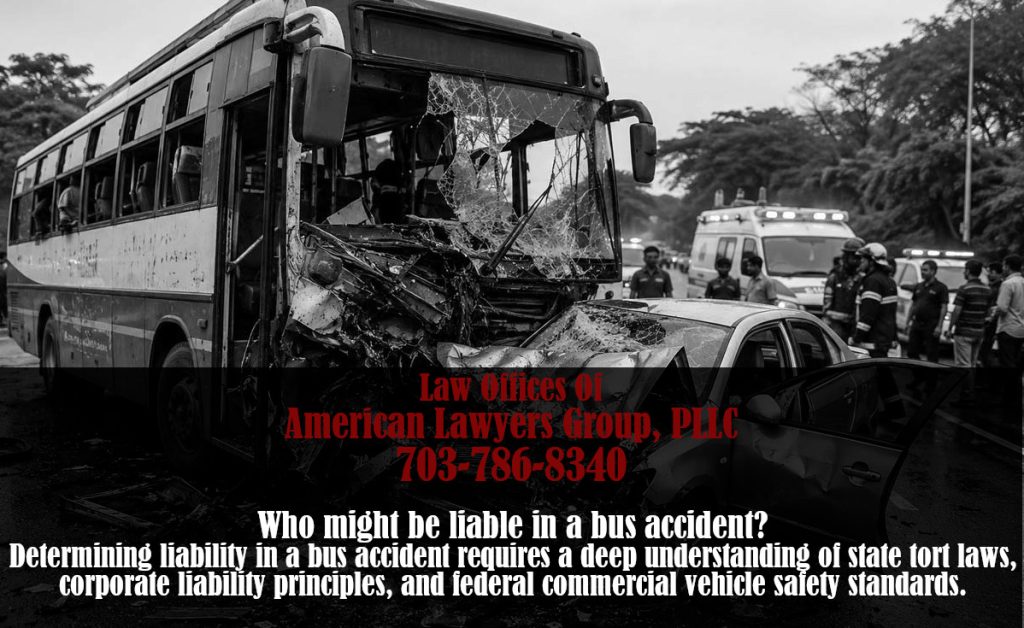
Depending on the specific circumstances surrounding the collision, one or more of the following parties may be held legally liable for your injuries:
The Bus Driver:
If the collision was caused by driver error, distraction, fatigue, speeding, driving under the influence of drugs or alcohol, or a failure to obey traffic control devices, the driver can be held individually liable. Common examples include a Fairfax Connector driver failing to yield the right-of-way or a tour bus operator driving past federally mandated hours- of-service limits.
The Bus Operating Company or Transit Entity
: Under the legal doctrine of respondeat superior (vicarious liability), an employer is legally responsible for the negligent acts of its employees performed within the course and scope of their employment. Furthermore, the company itself can be held directly liable for negligent hiring practices, failure to conduct background checks, inadequate training, or failure to properly supervise its operators.
The Maintenance Provider and Repair Facilities
: Buses require rigorous, continuous preventative maintenance to safely operate. If a mechanical failure occurs—such as a brake failure, tire blowout, or steering malfunction—and investigation reveals that the public or private entity outsourced maintenance to a third-party contractor who failed to perform proper inspections or executed faulty repairs, that contractor may bear substantial liability.
Third-Party Motorists
: In many instances, a bus accident is precipitated by the reckless or negligent actions of an ordinary passenger vehicle driver sharing the road with the bus. If another driver cuts off the bus, runs a red light, or swerves unexpectedly, causing the bus driver to crash or brake violently, that third-party driver can be held accountable for the resulting injuries to bus passengers.
Government Entities and Municipalities
: When the bus is owned and operated by a local municipality, county, or regional transit authority (such as Fairfax County or WMATA), the government entity itself becomes the primary focus of liability. Pursuing a claim against a government body introduces severe legal challenges rooted in sovereign immunity, which requires strict adherence to specialized statutory notice rules.
Vehicle and Component Manufacturers
: If a design defect or manufacturing flaw in the bus itself or its critical component parts (such as the braking system, seat belts, or tires) caused or exacerbated the accident, a strict product liability lawsuit can be brought against the manufacturer or distributor.
Types of Bus Accident Injuries
Because of the massive physical dimensions and weight differentials involved when a multi-ton bus collides with smaller passenger cars or structural barriers, the force of impact is immense. Furthermore, many transit buses are not equipped with standard passenger safety restraints like three-point seatbelts or airbags, and many feature standing-room-only configurations. When an impact occurs, passengers are violently thrown against metal handrails, hard plastic seats, fare boxes, or other passengers, leading to severe and life-altering physical traumas.
At American Lawyers Group, PLLC, our legal team routinely handles bus accident cases involving a broad spectrum of severe injuries, including but not limited to:
Traumatic Brain Injuries (TBIs) and Concussions
: Violently striking one’s head against a window, seatback, or the floor can result in severe brain injuries. These can range from mild concussions to permanent, debilitating cognitive deficits, memory loss, emotional dysregulation, and physical disability requiring lifelong specialized care.
Spinal Cord Injuries, Paraplegia, and Quadriplegia
: The extreme axial loading and rotational forces generated in a bus crash can cause herniated discs, fractured vertebrae, and severe spinal cord damage. In the worst cases, victims suffer partial or complete paralysis, fundamentally altering their quality of life and stripping them of their independence.
Complex Bone Fractures and Orthopedic Injuries
: High-impact collisions frequently result in broken arms, legs, ribs, clavicles, and pelvic fractures. These injuries often require complex open-reduction internal fixation (ORIF) surgeries, prolonged physical therapy, and may lead to chronic pain or permanent mobility limitations.
Severe Soft Tissue Trauma and Whiplash
: The violent, unexpected whipping motion of the neck and torso during an impact can tear muscles, ligaments, and tendons. These soft tissue injuries, while not always visible on standard X-rays, can cause persistent, agonizing pain and severely limit an individual’s capacity to work or engage in daily activities.
Internal Bleeding and Organ Damage
: Blunt force trauma to the abdomen or chest can cause life-threatening internal bleeding and lacerations to vital organs such as the spleen, liver, kidneys, or lungs, requiring emergency trauma surgery.
Psychological and Emotional Trauma
: The sheer terror of being involved in a major mass transit disaster can leave lasting psychological scars. Victims frequently suffer from Post- Traumatic Stress Disorder (PTSD), severe anxiety, panic attacks, depression, and a debilitating fear of riding public transit or driving.
Does it matter if the bus was operated by a public agency or private company?
Yes, it matters immensely. The legal distinction between a public, government-operated transit vehicle and a privately owned commercial bus company is one of the most critical factors governing how your personal injury claim must be structured, evaluated, and litigated under Virginia law. Failing to recognize this distinction immediately can completely bar you from recovering compensation, regardless of how clear the driver’s negligence may be.
Private Bus Companies
If you are injured in an accident involving a private charter bus, a commercial tour bus, a private school bus, or a corporate shuttle service, your case is governed by standard Virginia personal injury laws and commercial insurance regulations. Private companies do not enjoy the protections of sovereign immunity. To recover damages, you must demonstrate that the private carrier breached its duty of care as a common carrier and that this breach directly caused your injuries. Private commercial operations are typically backed by substantial commercial liability insurance policies, which are strictly regulated by federal entities like the Federal Motor Carrier Safety Administration (FMCSA).
Public and Government-Operated Transit Agencies
If the accident involved a public transit entity—such as the Fairfax Connector (operated under the authority of Fairfax County) or a local public school bus—the legal environment changes dramatically. Under the ancient legal doctrine of sovereign immunity, government entities are historically shielded from tort liability unless they explicitly waive that immunity by statute. Virginia has partially waived this immunity through the Virginia Tort Claims Act (VTCA) , which allows individuals to bring claims against the Commonwealth and certain public bodies under tightly controlled parameters.
When dealing with public agencies, several rigorous legal hurdles must be cleared:
Statutory Notice of Claim Deadlines
: Unlike private lawsuits where you have years to file a case, claims against public entities require the filing of a formal, highly specific written “Notice of Claim” within an incredibly brief window. For claims against the Commonwealth or a state agency under the VTCA, this written notice must be filed within one year of the date of the accident. However, if the claim is against a local municipality, town, or county (such as Fairfax County itself ), Virginia Code § 15.2-209 mandates that a strict written notice must be delivered to the county or city attorney within six (6) months of the injury. Failure to file this precise notice within the 6-month window completely destroys your right to sue.
Strict Statutory Damage Caps
: Under the VTCA, damages recoverable against a state government entity are strictly capped at $100,000 or the maximum limit of any applicable insurance policy, whichever is greater. This can pose a major challenge if multiple passengers are severely injured in a single crash and must split a limited pool of funds.
How long do I have to bring a claim after a bus accident in Virginia?
In the Commonwealth of Virginia, the time frame within which you are legally permitted to file a personal injury lawsuit is governed by a strict legal deadline known as the statute of limitations. If you miss this deadline, Virginia courts will permanently dismiss your case, and you will lose all legal recourse to recover compensation for your medical expenses, lost wages, and pain and suffering.
Pursuant to Virginia Code § 8.01-243, the general statute of limitations for personal injury claims resulting from negligence is two (2) years from the exact date on which the accident occurred. This two-year timeline applies directly to claims brought against private individuals, private charter bus corporations, and commercial manufacturers. While two years may seem like an ample amount of time, building a robust, trial-ready commercial bus accident case requires months of intensive investigation, expert witness consultations, medical record review, and accident reconstruction.
Warning Regarding Government Claims
: As detailed previously, do not confuse the general two-year statute of limitations with the mandatory administrative notice deadlines for government entities. If you are struck by a Fairfax County public bus, you must file your formal written Notice of Claim within 6 months, even though you technically have up to two years to file the actual lawsuit in a Virginia circuit court. Missing the 6-month notice deadline renders the 2-year statute of limitations entirely irrelevant.
There are very few, highly narrow exceptions that may “toll” or pause the statute of limitations in Virginia:
Minor Victims
: If the injured victim was a child under the age of 18 at the time of the bus accident (a common occurrence in school bus accidents), the two-year statute of limitations is generally tolled until the minor reaches their 18th birthday. This means a lawsuit must be filed before the individual turns 20. However, claims for medical expenses paid by parents belong to the parents and remain bound by the standard two-year deadline.
Incapacitated Individuals
: If the victim suffers a severe traumatic brain injury or is otherwise rendered mentally or physically incapacitated as a direct result of the crash, the statute of limitations may be paused until a legal guardian is appointed or the incapacity is resolved.
Can I recover damages if I was partially at fault?
This is perhaps the most challenging and unforgiving aspect of pursuing a personal injury claim in the Commonwealth of Virginia. Virginia is one of only a tiny handful of jurisdictions in the United States that still strictly adheres to the traditional, harsh doctrine of pure contributory negligence.
Under the rule of pure contributory negligence, if an injured plaintiff is found to have contributed even a fraction of a percent to the cause of the accident through their own negligence, they are completely barred from recovering any damages whatsoever from the other negligent parties. In practical terms, if a jury determines that a bus driver was 99% at fault for a collision because they were speeding, but concludes that you were 1% at fault because you stepped out into a crosswalk against a changing signal or failed to exercise ordinary care, you will receive zero compensation.
Because of the devastating finality of this legal rule, insurance companies representing public transit authorities and multi-million dollar private bus lines heavily rely on contributory negligence as their primary defense strategy. They will combed through your medical records, review any statements you made at the scene, analyze cellular data, and look at surveillance footage to find any behavior they can characterize as negligent. Common arguments raised by defense attorneys to establish contributory negligence in a bus accident context include:
• Claiming a passenger was standing up or moving about the bus unnecessarily while the vehicle was in motion, contrary to posted safety warnings.
• Arguing that a pedestrian or bicyclist was distracted by their smartphone or wearing noise- canceling headphones, failing to notice the approaching bus.
• Asserting that a driver in another vehicle was tailgating the bus or failed to properly signal before changing lanes, contributing to the ultimate collision.
To successfully overcome a defense based on contributory negligence, your legal team must construct an ironclad case demonstrating that your actions were entirely reasonable under the circumstances and that the defendant’s negligence was the sole proximate cause of the crash. There are very rare legal counter-doctrines, such as the Last Clear Chance Doctrine, which may allow a partially at-fault plaintiff to recover if they can prove that the defendant had a clear opportunity to avoid the accident but failed to do so. However, successfully arguing these advanced concepts requires top-tier litigation skills.
Experienced Result Oriented Bus Accident Attorneys In Fairfax
Call Now – FREE Consultation
Why Choose Our Team for Bus Accident Claims in Fairfax?
When you are recovering from severe, painful injuries and facing financial disruption, selecting the right legal representative can make all the difference in the outcome of your case. Bus accident litigation is a highly specialized arena that demands trial-tested experience, substantial financial resources, and an intimate familiarity with the local courts and legal culture of Fairfax County.
At American Lawyers Group, PLLC, we bring an elite level of advocacy and personal dedication to every client we represent. Here is why injured victims and their families trust our firm to handle their bus accident claims in Fairfax:
Deep Mastery of Local and State Transit Regulations
: Our attorneys possess a comprehensive, working command of the complex regulatory frameworks governing mass transit in Northern Virginia. We understand how to navigate the bureaucratic mazes of Fairfax County risk management, the Virginia Tort Claims Act, and the federal safety guidelines set by the FMCSA. We know exactly what evidence to demand—including black box event data recorders, interior digital surveillance footage, driver logbooks, and maintenance schedules.
A Personalized, Client-Centric Approach
: We know that you are a person going through a profound crisis, not just another case number on a folder. Our legal team treats every client with the utmost compassion, empathy, and respect. We maintain open lines of communication, ensuring you receive regular updates on the progress of your investigation and that your questions are answered promptly and clearly. We handle the stressful legal battles so that you can focus 100% on your physical and emotional recovery.
Aggressive and Tenacious Litigation Tactics
: We do not back down when facing large corporations, powerful government agencies, or stubborn insurance defense networks. Our lawyers prepare every single case from day one as if it is headed to a full trial in front of a Fairfax County jury. This meticulous, aggressive approach signals to insurance companies that we will never accept a lowball settlement offer, maximizing your leverage during negotiations.
No Upfront Fees – Contingency-Based Representation
: We firmly believe that everyone deserves equal access to top-quality legal representation, regardless of their financial
situation. That is why we handle all personal injury and bus accident claims on a strict contingency fee basis. You pay absolutely nothing out of pocket to retain our services, and we cover all upfront costs associated with investigating your claim, filing lawsuits, and hiring expert witnesses. We only get paid if we successfully secure a financial recovery on your behalf through a negotiated settlement or a court verdict.
If you or a loved one has suffered injuries in a bus accident within Fairfax County or the surrounding Northern Virginia communities, do not leave your future to chance or allow aggressive insurance adjusters to dictate your recovery. Contact the experienced legal team at American Lawyers Group, PLLC today to schedule a confidential, no-obligation initial consultation. Let us stand by your side and fight for the full justice and compensation you rightfully deserve.